

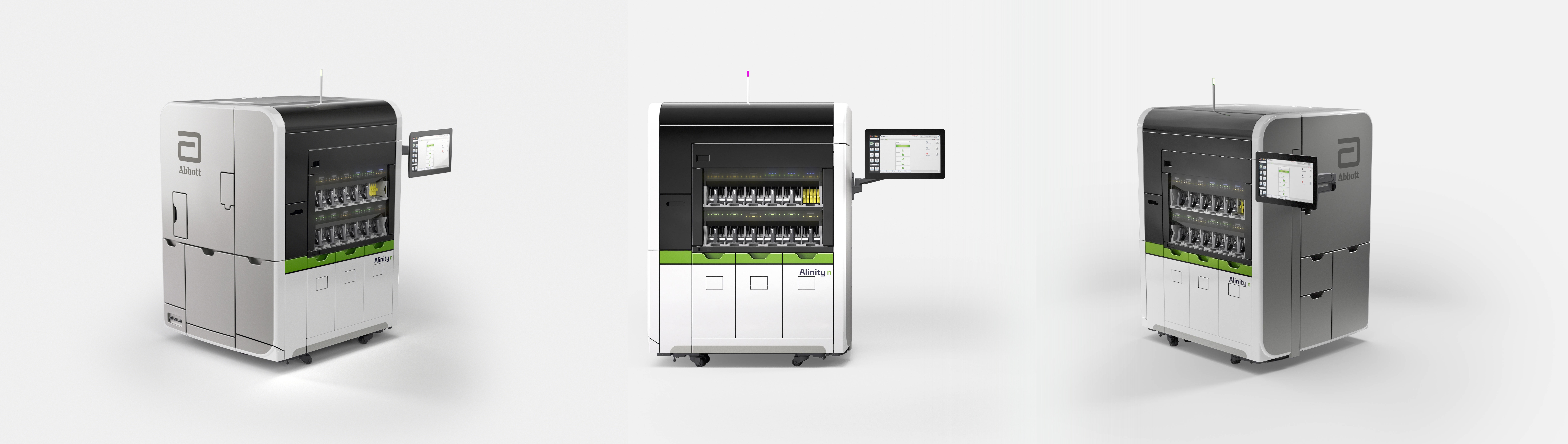
Alinity n* is purpose-built for blood, plasma and organ donor screening - combining isothermal recombinase polymerase amplification (RPA) technology with unique design features.
Alinity n redefines what your laboratory can achieve — with the goal of setting a new standard for efficiency, simplicity, and flexibility.
*Alinity n system is CE marked. Not all products available in all markets. Alinity n assays are under development and not commercially available for donor screening.
Alinity n is the first transfusion and molecular instrument to use Recombinase Polymerase Amplification (RPA) technology.

THE SCREENING IMPERATIVE
Blood safety demands more
than today's NAT can deliver
NAT for donor screening has remained largely unchanged for decades and was designed for the workflows and requirements of that time, and some may not fully align with today's evolving donor screening processes.
Purpose-built for blood and plasma screening, Alinity n* is designed to drive advancements on multiple fronts. Not by incrementally improving existing architecture, but by building an entirely new platform around the demands of the modern blood and plasma screening environment.

NAT innovation
Molecular performance matched to serology-class speed

Fast TAT
Faster availability of blood than traditional instruments for laboratories prioritizing IDT

On-board pooling
Innovative on-board pools and deconstruction

Batch free testing
On the fly, continuous random access processing
*Alinity n system is CE marked. Not all products available in all markets. Alinity n assays are under development and not commercially available for donor screening.
Alinity n is the first transfusion and molecular instrument to use Recombinase Polymerase Amplification (RPA) technology.
THE SCIENCE BEHIND THE BREAKTHROUGH
Recombinase Polymerase Amplification —
a new amplification paradigm for donor screening
RPA operates at a stable, low temperature — eliminating the thermal cycling that can constrain conventional NAT and enabling the kind of continuous, high-throughput processing blood and plasma programs demand.


Isothermal amplification
Traditional PCR-based NAT platforms rely on precise thermal cycling—shifting temperatures through multiple phases of denaturation, annealing, and extension. While highly effective, this temperature-dependent process inherently adds time to each run and can limit throughput and testing flexibility.
An alternative isothermal amplification method, Transcription Mediated Amplification (TMA), does not require thermal cycling. However, it does not resolve the challenges of processing time and some implementations rely on sequential, batch-oriented workflows that may limit true random-access operation.
Both PCR and TMA methods generate results within hours.
Recombinase Polymerase Amplification (RPA), as implemented on Alinity n*, takes a different approach. It operates at a single, constant temperature, eliminating the need for thermal cycling and reducing overall processing complexity to deliver a result in as few as 35 minutes. Combined with the system’s continuous, random-access design, this enables faster time-to-result and supports more flexible, efficient sample processing - an important advantage in high demand donor screening environments.
First-of-its-kind* application for donor screening
RPA has been applied in point-of-care and research - But Alinity n marks its first deployment in a fully automated, high-volume donor screening context.
*Alinity n system is CE marked. Not all products available in all markets. Alinity n assays are under development and not commercially available for donor screening.
Alinity n is the first transfusion and molecular instrument to use Recombinase Polymerase Amplification (RPA) technology.

INNOVATION STARTS HERE
Five ways Alinity n* could strengthen
your screening program
Each capability was designed around a specific operational constraint facing blood and plasma screening laboratories today.

01 — TAT
Supply blood at speed
Alinity n is built for laboratories that cannot afford to wait. Designed for a 35-minute TAT for plasma protocols and 42 minutes for whole blood, it supports a confident shift to individual donor testing while bringing greater structure to operating schedules.
Data on file at Abbott.

02 — Throughput
Do more with less — in every square meter
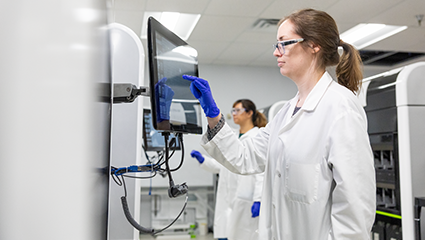
Alinity n is designed to maximize what your laboratory can achieve within its existing footprint. Running up to 150 IDT tests per hour, and delivering up to 1,877 samples per m² in a single 24-hour cycle, it helps you drive higher output without expanding your lab.
Data on file at Abbott
03 — Pooling
Pooling built-in — simplicity gained
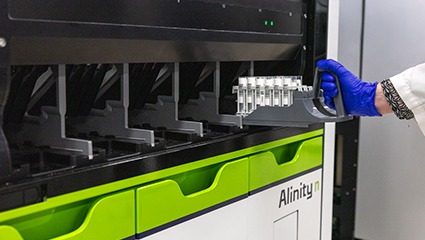
Alinity n removes the complexity from pooling decisions. It is designed for innovative on-board pools of 2 or 6 — including automated deconstruction — your laboratory gains the operational freedom to optimize workflows your way. One integrated system that adapts to your program, not the other way around.
Data on file at Abbott
04 — Random access
No more batching — every sample on demand
Alinity n redefines how your laboratory processes samples. By moving beyond the traditional PCR plate format, each individual reaction vessel operates under isothermal conditions — designed to enable true continuous random access and the ability to run a mix of different assays simultaneously. No waiting to fill a batch. No workflow interruptions. Every sample is processed the moment it's ready, giving your team the operational agility to respond to demand in real time.
Data on file at Abbott

05 — Partnership
Design your future lab — with experts by your side
This is your opportunity to build the laboratory your program has always needed. Abbott's dedicated total solution team — spanning transfusion medicine workflow, applications, informatics, and automation — works alongside you to co-design lab systems and processes built around your specific goals. Through workflow modeling, on-site observations, and process mapping, you gain the clarity and confidence to move forward — and the expertise to get it right.
*Alinity n system is CE marked. Not all products available in all markets. Alinity n assays are under development and not commercially available for donor screening.
Alinity n is the first transfusion and molecular instrument to use Recombinase Polymerase Amplification (RPA) technology.
GET STARTED
See what Alinity n* could
mean for your donor
screening program
Connect with Abbott to explore how Alinity n fits your specific environment and volume requirements.
*Alinity n system is CE marked. Not all products available in all markets. Alinity n assays are under development and not commercially available for donor screening.
Alinity n is the first transfusion and molecular instrument to use Recombinase Polymerase Amplification (RPA) technology.